Tuesday, June 25, 2013

Lego Faces Get Angrier

The classic smiley faces of Lego figures are being increasingly replaced with more angry faces. Dr Christoph Bartneck, a robot expert at the University of Canterbury in NewZealand studied 3,655 figures produced between 1975 and 2010.  He concluded that the company was increasingly creating more themes based on conflict.  
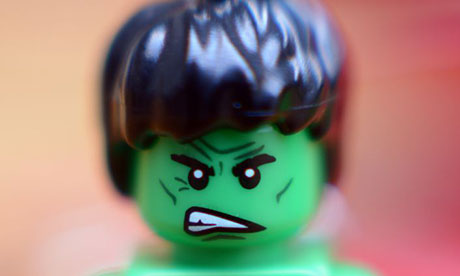
  
On one hand, I’m pleased that the new faces represent a greater range of emotions; on the other hand, I’m concerned that this increase in emotional faces is skewed towards negativity.   If there were an equal representation of caring emotions, like compassion, sympathy, and love, I’d welcome the change.  When the increase in emotions is predominately negative, it makes me wonder what impact it will have on kids play.  Will it lead to more scenarios focused on aggression and conflict? 

I’m not opposed to having negative emotions on Lego figures; in fact, I think it could be helpful. Kids need ways to process the anger they feel and the conflicts they observe. My play therapy room has always had aggressive toys. When kids need to discharge angry feelings they regularly play with guns, swords, a punching bag or dart board.

Adults can talk out things that bother them, but children act out their angry feelings through play. They engage in imaginary games with themes of good and evil. How these games are played out has a lot to do with the society children grow up in. They model what they’ve been exposed to. Even kids from the most loving households, see that the larger society’s take on anger is most often represented as out of control aggression. Movies and games are full of this violent, hurtful behavior. We simply don’t have models for anger that represent healthy assertiveness. Assertiveness is standing your ground in a respectful way. It’s not wimpy; it’s just not with the intent of destroying someone else.
 
How about a new Lego character named Master Negotiator. He’s the embodiment of healthy assertiveness and fairness. Though he is strong and powerful, his status is derived by never creating an enemy. He is known for his uncanny skill at seeing both sides. He looks for common ground and is never undone by criticism. He easily admits when he’s wrong and always apologizes. His focus and determination are unmatched in finding creative and novel solutions. Wow!  That would be a hero I could get behind!


Wouldn’t we want kids to emulate Master Negotiator? To think that creative solutions rather than revenge and retribution were the right skills to cultivate? Ah, fantasy. Do I wish we were this focused on creating superior interpersonal skills? That we were emotionally intelligent and able to manage our angry impulses to find win/win outcomes? Of course I do-- it’s less showy than violence and destruction. But, in reality it probably won’t sell many movies, even though it’s much harder and requires more intellectual and emotional control than out of control aggression.  

Oh well, one can dream.

Friday, June 14, 2013

The Whole Brain Child, An Exciting New Book

Dan Siegel and Tina Payne Dryson’s new book, The Whole Brain Child, is a resource you won’t want to be without. It’s crammed full of information and helpful explanations of children’s behavior based on how their brains work. The book is reader friendly and translates complex neuroscience into clear understandable language. The authors explain how children’s brains are different from fully mature brains, and how understanding the difference can help adults have more realistic expectations of children and develop  more effective interventions. 


To begin, they explain how the two hemispheres of the brain work. These two sides are not only anatomically separate but they also function in very different ways.  The right hemisphere is intuitive and emotional, while the left hemisphere is logical and literal. The reason being is the importantance to understand these distinctions as young children are right hemisphere dominate, especially during the first three years. Emotions rule and they live in the moment. They’re unable to use logic and words to express their feelings.  It’s up to us to help them by listening to them with our own right brain.   When we first hear their emotions they will then be receptive to reason and logic.
 
This, of course, is not true just for children. Think of the last time you were in the throes of a strong emotion and someone was trying to get you to be logical. I bet you didn’t find it helpful. When we’re very emotional we literally have difficulty processing information.  Our system need to calm down first. An interesting research study illustrated this point. Subjects in the study were asked to look at pictures of angry and frightened faces. Exposure to the pictures increased blood flow to the fear centers in their brains.   But when the subjects were asked to name the emotion on the faces, the fear centers calmed down with decreased blood flow to that area. In addition, blood flow increased in the right prefrontal cortex, a part of the brain that helps us in regulating our emotions. Based on this research, we may conclude that just naming the emotion helps us calm down.

We may fear that addressing children’s emotional response to situations and naming what you think they’re feeling will make things worse. In fact, as this study showed, this will actually calm things down rather than stir them up.   I think in our rush to help children calm down, we sometimes ignore or diminish how they are truly feeling.  After we’ve helped them manage their emotions, we can help them access the logical part of their brain and in the process connect the emotional part with the logical part.   We can then ask questions, consider what prompted the upset, help them see another’s point of view, and problem solve for new solutions.  This integration of both parts helps us make good decisions and function at our best.

Another area of our brain where separate parts need to be integrated is what the authors call the upstairs and downstairs brain.  The downstairs brain is our more primitive brain, which is intact at birth.   Our upstairs brain is our reasoning brain; it is the upstairs brain that helps modulate our downstairs brain when we’re totally overloaded and lose it.   Similar to the contrast between the right and left hemisphere, the downstairs brain, like our emotional right brain, can call the shots.   In both cases we want the two parts to work in harmony.  We want to be aware of our needs, impulses, and desires, but we also want some modulation so we make good choices and don’t later regret our actions.  The book gives good explanations and cartoon vignettes that illustrate the way the two areas of the brain work best together. 

There is also a discussion of tantrums, which is a hard problem for parents to deal with.  The authors give clear guidelines about how to distinguish between an upstairs tantrum and a downstairs tantrum.   The upstairs tantrum is a calculated bid for getting our way, and requires limit setting and consequences.   The downstairs tantrum is a real meltdown and a temporary inability to manage ourselves.   This tantrum needs your adult help and support.

A section about preventing trauma explains how fearful memories are laid down and how to prevent future problems relating to them.  They explain the importance of remembering upsetting things rather than burying them and keeping them out of our awareness.   Rather, they suggest that if we remember the fears, we give our brain a chance to learn and grow.   If we avoid those problems, we risk experiencing the trauma over and over.  This is especially important to me, since I see so many clients who have hidden upsetting experiences that still affect them.   Too often we’ve been told to just forget upsetting things.   The Whole Brain Child gives scientific explanations of why ignoring fears and trauma isn’t always the best policy.    There are some very helpful, concrete examples of how to help kids work through, and not avoid, disturbing incidents.

The book points out the critical role adults play in helping children learn to integrate the different parts of the brain.   We can help children regulate the downstairs brain by using their upstairs brains, and to help them use their logical left hemisphere to temper the emotional right hemisphere.  Learning to use the whole brain wisely will ensure their best chance for intellectual and emotionally healthy development.   


This book is important reading for anyone who lives or works with children.   I recommend it highly.

Wednesday, May 22, 2013

Coupled Emotions

When I wrote, Yell and Shout, Cry and Pout: A Kid’s Guide to Feelings, which describes our eight basic emotions, I searched for a way to help kids remember them more easily.   My solution was to group two emotions together based on how they affected our nervous system.


The first group of emotions I put together was Anger and Fear.   I labeled them as emotions that make us TENSE AND TIGHT.   Anger and Fear both pump up our nervous system.   They energize us for fight or flight.    Anger needs this increased arousal for potential protective maneuvers.    Fear needs this as well to keeps us edgy so we notice everything and assess threats to our survival.

The second group of emotions I paired was Shame and Sadness.   I labeled them as emotions that make you SAGGY and SLOW.   These emotions represent a decrease in our arousal level and cause a temporary dip in energy.  We are slowed down and loose enthusiasm for things that once pleased us.    Shame makes us introspective and question ourselves.    Sadness is our reaction to a loss or rejection; we withdraw to reflect and remember.  

The next grouping is Happiness and Love.   I labeled them as emotions that make you LOOSE and LIGHT.   These are emotions that put us in a state of harmony where our body is relaxed and at ease.   Things are working smoothly and we feel open and receptive.   Happiness is a place of pleasure.  It makes us cooperative and easy to be with.   Love allows us to be intimate with others, to share ourselves and be caring and kind.  


The last grouping is Disgust and Surprise.  These are the emotions that make us UNEASE and QUEASY.  Both these emotion cause immediate physical reactions; compelling us to react.   Surprise is like an alarm that demands our attention.  It stops us in our tracks so we can pay attention and assess what’s happening.  Disgust is our automatic reaction to anything that seems noxious.   We withdraw and try to avoid whatever smell, taste or touch might be tainted or unhealthy.

For more information on emotions and how to help children understand and express their emotions, visit my blog.


Wednesday, May 15, 2013

Increase Your Child’s Self Esteem by Telling Family Stories

I just finished a fascinating article that looked at the impact of tellingfamily stories. It turns out that kids that know a lot about their families do better when they face challenges.  Dr. Duke and Dr. Fivsush asked kids questions like:  Do you know where your parents met? Do you know something really terrible that happened in your family?  Do you know the story of your birth?  They administered their questionnaire, “Do You Know?”, to four dozen families and compared the answers to the psychological tests the kids had taken earlier.  Their conclusion was that the more kids knew about their family’s history the stronger their sense of control over their lives, the higher their self-esteem and the more successfully they believed their family functioned. 


While having a strong family narrative is valuable, it’s the particular type of narrative that best predicts to family cohesion and consequently to children’s resilience.  There are three types of family narratives.   One is an “ascendance narrative,” in which the family does well.   The theme of the story is the rags to riches story.   The second is a “descending narrative,” in which trouble and travail beset the family that never seems to get ahead.   The third narrative is an “oscillating narrative.”  In it the family sometimes suffers setbacks and sometimes achieves triumphs, but, most importantly, the family sticks together through it all.   Dr. Duke speculates that children with this narrative develop what he calls a strong “intergenerational self.”   I think it reflects the comfort we all feel in knowing we are part of something bigger than ourselves, that we belong to a family that has traditions and survival skills that help manage life’s struggles.

 My guess is that children who hear “oscillating narratives” also develop a more realistic understanding of life’s ups and down.   Facing setbacks might be easier for them.   Perhaps they are better equipped to see failure as a temporary state that can be overcome.    And so those experiences of setbacks become lessons of courage. I’m reminded of Joseph Campbell’s study of myth and his writing about the journey of the hero. The hero is never consistently successful in his quest.   Often he has serious obstacles to overcome and almost always there are times of self doubt, as well as, the need to seek advice from others.   Perhaps this is the message that comes across in “oscillating narratives.” 

 It’s reassuring to know that stories of difficult times are as important to include in family history as success stories.    Given this new research you might want to think about what family themes you want to emphasize and share with your children.  Elaborate your stories to demonstrate how family members helped one another.  Make it interactive and ask your children what they would have done in a similar situation.   Talk about the fun celebrations as well as sad occasions.    Create a family story album with pictures to accompany the stories. 
 

For more information on helping your child express their emotions, you can pick up a copy of my new book, Yell and Shout, Cry and Pout: A Kid’s Guide to Feelings, available now!

Tuesday, April 30, 2013

Guest Blog-Parents and Apologies, By Ellen D. Begley, RN, NCC, LPPC.


I’m really pleased to announce my guest blogger, Ellen D. Begley, RN, NCC, LPPC of Sixty Second Parent.  Ellen’s blog, “Parents and Apologies,” helps us understand why it’s important to apologize to our children when we’ve been wrong, overreacted or have been unreasonable.   Sometimes we hesitate because we don’t want to weaken our authority.  Or perhaps, we’re ashamed and don’t want to admit it.   Or maybe we believe that it will be forgotten and we won’t have to do anything.  But whatever the reason for our hesitation, we need to think twice about not apologizing.   I believe not owning up to our mistakes makes things worse, not better.  Can’t we all remember childhood hurts that still feel vivid?  They stick with us because they angered us and seemed unfair.   What was needed in those situations is exactly what Ellen talks about, sincere apology and restoring trust in the parent-child relationship.


Parents and Apologies


It is a special strength of a self-confident parent to admit mistakes, and the acknowledgment of occasional shortcomings affirms our humanity to our children.  Genuinely admitting our lack of perfection allows our children to understand that the standard for proper behavior is not error-free living, but rather learning to live responsibly in community with others.  Many people will use the term “sorry” loosely; but when you are wrong or have wronged another, genuinely saying “I’m sorry” is hard work.  Parents are the most important role models for their children.  Consequently, admitting mistakes and apologizing are behaviors that need to be modeled. 


We are not perfect!!!  It is OK to be human.  We were not meant to be perfect; and if we appear to be perfect to our children, we instill in them a tremendous pressure to strive for an unreasonable and impossible standard.  Alternatively, when we insist that we are right, and our children know that we are not, we lose trust and respect.  Apologizing for mistakes teaches our children to accept responsibility for their behaviors and to seek reconciliation.  Power struggles within families can often be defused with a genuine apology.

When apologizing to your children:
·          Be genuine.  The most important thing about apologies is the genuineness by which they are given.
·          Don’t use apologies to make your point.  “I was wrong, BUT …” is no apology. 
·          Connect emotionally.  Apologies give us the opportunity to connect with the other person on an emotional level and therefore must be given in the right context.  If you are feeling angry or hurt, wait until you can be tuned into your kids and open to their feelings.
·          Communicate your words in an appropriate manner.  The words used are not as important as the way in which they are stated.  The words themselves can be as simple as “I’m sorry, I was wrong”.  I tell my kids that I am not a perfect parent; nevertheless I am the parent God chose for them, and I will try to do my best for them.
·         Value the relationship.  It is part of our relationship as family to admit our wrongs, just as we celebrate with each other our gifts and successes.

Remember that our forgiveness in response to our child’s apology, the other side of this “coin”, is an equally important behavior to model to our children.

By Ellen D. Begley, RN, NCC, LPC for www.sixtysecondparent.com - Ellen is a registered nurse as well as a licensed and national board certified counselor. She has a private practice that serves children ages 2 to 18 and has over 18 years of experience counseling children and educating parents.